Step 3 - Strategy Building
To avoid overcomplicating things (if I haven't already…) I was going to include this section towards the end of this website, but I think you need to at least be aware of these things before we jump into the property selection discussion.
There are a variety of value-add strategies that you can do in property that can fuel your investing journey either in the accumulation and / or consolidation phase. Note that these are not must-haves, you don't have to execute these strategies to be a successful investor, but when selecting a property to purchase it can be useful to see if it will have the potential to use any of these strategies so you can have the option to pull the lever on these strategies if you want to.
Strategy
Purpose
Granny Flat
Cosmetic Renovation
Development / Subdivision
Improve cashflow
Improve cashflow as well as value up-lift
Debt reduction
Overview
Granny flats are self-contained secondary dwellings which are built on the same block of land as the main house - typically at the back of the block. Their main purpose is to improve the cashflow of a dwelling for your retirement after your consolidation phase or to make them easier to hold during your accumulation phase (i.e. by increasing the yield).
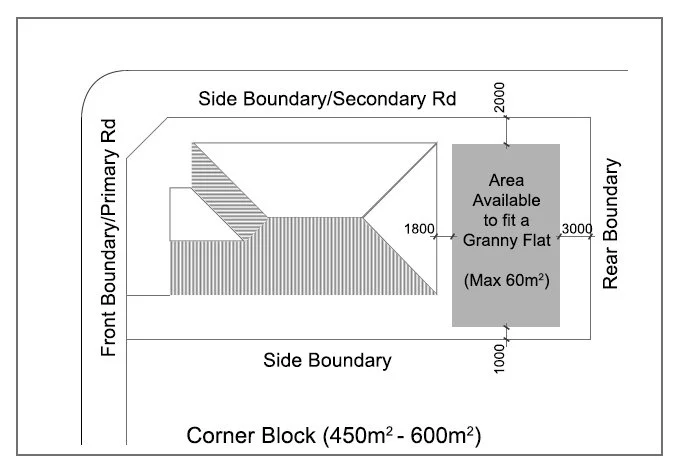
Every council in Australia will have different rules and regulations regarding granny flats so it is important to check with a town planner before you make any decision to build a granny flat on a property you purchase. However, generally speaking, your block needs to be at least around 600m2 (maybe less in places like Sydney and Melbourne), with the main dwelling positioned towards the front of the block and ideally with a separate road access or at least side access.
Please see the image on below as an example of a site which could be appropriate for a granny flat.
There is a lot of content online these days about granny flats including their costs so I recommend you check that out - including this video by Luke Wiles, who is Brisbane based by the way so not all the information may apply to you.
One thing to remember with granny flats, if your plan is to sell this property down the track you will most likely only be selling to investors as most owner-occupiers don't want a secondary dwelling in their backyard - which may result in you achieving a lower sale price (but not always, depends on the local demographic) .
A cosmetic renovation in property investing refers to surface-level improvements that make a property look fresher, more modern, and more appealing, without changing the structure or layout of the home. This usually means that you won't need council approval to do any cosmetic renovations.
This doesn't include things such as replacing the gutters, replacing the roof, installing new shelves etc. (i.e. things that buyers / tenants won't pay more for), instead it refers to things such as the following:
General Renovations
Painting the walls and ceilings using light and neutral colours, ideally just go with a natural white (nothing too bright or dark).
Updating the flooring with new carpets, polishing old wooden floorboard (they may be hidden under the existing flooring if you are lucky!) or installing new vinyl floorboards.
Replacing light fittings with new and more modern options.
Replacing handles on doors, wardrobes and other cupboards.
Replacing blinds or curtains with new and more modern options.
Kitchen Renovations
Repainting or resurfacing benchtop.
Installing new cupboard handles.
Replacing tapware with modern alternatives.
Bathroom Renovations
Repainting wall tiles and bathtub (avoid feature walls…).
Upgrading vanity and tapware (including the mirror / cabinet).
Upgrading showerhead and / or shower screen.
Installing a new toilet, towel rails and toilet paper holder.
Whilst it can be tempting to do all of the above to a property if you have the money, it is important that you only do renovations if they:
(1) Will give you a strong return on investment
For every $1 you invest in the renovation you want the value of your home to improve by at least $2 - $3. It is essential that you don't overcapitalise when you are renovating - the general rule of thumb is that you don't want to spend more than 10% of the property's value on the cosmetic renovation.
Check out this video from Luke Wiles for more information on assessing whether a renovation will make you profit.
(2) Are necessary or advantageous in the current circumstances
If the property is currently not tenantable, then the cosmetic renovation will obviously be necessary. However, if it is tenantable according to your property manager don't feel obligated to renovate it just for the sake of it (don’t place much weight on your own opinion… you aren't the one living in it) .
If you are in need of more equity in the property so you can use it to purchase another property or you want to increase the rental return on this property to make it easier to hold from a cashflow perspective then these are both valid reasons for doing a renovation. However, ideally, we want to be reserving these scenarios for once the market that your property is situated in has slowed down from a growth perspective so that you can still manufacture equity / growth even when the market is not that strong.
I have actually recently renovated a property that I purchased in Frankston VIC in early 2025 and produced more than $200k equity from a $40k renovation, if I can be bothered I'll do a YouTube video on this to give you a good example of a cosmetic renovation - all this to say, this is a great strategy that I've used also.
I am not going to touch on this topic too much as development is a whole different beast of its own and I am not a developer myself. But one way that you can generate a large chunk of profit to pay down your debts quicker in the future is through purchasing properties with development potential.
This includes, amongst many other things, buying a property that is both large enough and has (or will likely have in the future) the correct zoning for development.
This development could include building a whole new home at the back then subdividing it (with council approval…) so it can be sold as a separate house or it could mean doing a complete knock-down in the future and building a few townhouses on the land. You don't even need to actually build the development yourself, you can just get plans approved by council and sell the land to a developer. I recommend checking out this below video from Redom Syed which I think is really interesting (but don't get too caught up on it, this is relatively advanced).
Development can make you some serious returns if done correctly; however, it can also be very risky so if you are newbie I would recommend you don't go into development in the start of your journey but you should at least be conscious of houses that may have future development potential in case it is something you are interested in later down the track.
In terms of creators who specialize in development, check-out Davey Hamilton - I have linked one of his videos below for your reference.
Outdoor Renovations
Render / repainting external walls and fence.
Pressure cleaning driveway and pathways.
Laying new turf, trimming over grown trees and just generally tidying up the yard.
Landscape with hedges on bark and nice plants.
Upgrading items such as letter box, street number and front door.