Step 2 - Building Your Team
CORE TEAM MEMBER - BUYER’S AGENT
For those of you who don't know, a buyer's agent as the name suggests represents the buyer (i.e. you), not the seller. They are supposed to do this by researching markets, evaluating properties to buy and negotiating or bidding at auction on the buyer's behalf. The price of their services varies significantly but can range anywhere from $10,000 to over $40,000 (expensive I know…).
Whether or not you should use a buyer's agent is one the most hotly debated questions in the property investing community and is usually broken down into two perspectives:
Buyer's Agent Path: You should use a buyer's agent because they are experts who have the time and resources to dedicate their day to researching the best areas, building agent relationships and getting you access to the best properties, including off market opportunities.
D.I.Y. Path: You do not need a buyer's agent because everything they do can be learnt through proper education so you can just avoid paying the fee by doing it yourself. Some argue that this will ensure you secure a better deal as there are a lot of unethical buyer's agents who are not motivated to purchase you the best property for your brief but rather their goal is to just sell you a property as fast as they can so they can collect their fee and move on to the next client (i.e. they have a churn and burn business model).
In reality, there is an element of merit to both of these positions and the truth lies somewhere in the middle of both in my opinion, so here is my 2 cents on the debate.
When should you use a Buyer’s Agent?
I believe that you should consider using a buyer's agent if any of the following applies to you:
You don't have an interest / passion in property investing but you recognise it is useful as a vehicle for building wealth so you still want to invest in the asset class
You don’t have time to research and purchase a property yourself
You don't have the confidence to take action on your own and / or you get 'analysis paralysis'

Property investing can be an emotional rollercoaster, so if it is not something you enjoy you may find yourself just 'settling' for any property you can get your hands on so you can move on with your everyday life - in which case you should consider outsourcing the process to a buyer's agent; however, if you are reading this 70,000+ word website I would say you may have at least an inkling of interest in this stuff and therefore you may want to consider investing in your education and trying the D.I.Y approach.
This is something you need to be really honest with yourself on, just because you have a full time job and a family doesn't mean you don't have time - it truly can only take a few hours each week to purchase your own investment property once you are educated. However, if you keep lying to yourself and saying you have the time to do so but in reality you don't, you are just delaying your entry into the market which will cost you money (probably more than the buyer's agent fee if they are a good one…).
From my experience, some people just do not have the confidence in themselves to be able to make a big purchasing decision such as buying an investment property without getting that feeling of a 'tick of approval' from a professional. Alternatively, there are some people who have too much self-belief in my opinion and just a buy a property with only doing surface level research - everyone is different. However, by investing in property education and reading websites like this one you should naturally build the confidence to invest on your own, but with that being said I know plenty of people who have spent thousands on property education but have never actually pulled the trigger on a purchase - it ultimately comes down to you and what you feel comfortable doing.
If the above statements don't apply to you, don’t sell yourself short, think about doing it yourself - it is more than possible and will save you a lot of money in fees. Equally, be honest with yourself and if any of the above do apply to your situation, think about using a buyer’s agent.
I have no issue with taking either of these paths - both can work. Whilst I was working in London I used a buyer's agent as I was working 16hr+ days almost every day and the time-zone difference made it almost impossible to find the time to invest in property; however, since I've returned back to Australia I am using the D.I.Y method - it all depends on your personal circumstances and motivations.
It isn't my job to tell you whether to take the DIY path or the buyer's agent path, both can work but one may suit your situation more than the other - you need to have an honest conversation with yourself and figure out what is best for you; however, I will lay out what each of these path entails so that you can make a more educated decision on which route to take.
For those who want to watch a more detailed debate on whether buyer's agents are worth the fee check out these videos.
Option 1: D.I.Y Investing
So how do you learn how to invest in property yourself without using a buyer's agent? It is actually quite easy:
Step 1: You need to invest in your property education.
Step 2: Take action.
That’s all it takes really.
When I say invest I am referring to your time and, in my opinion, your money. Yes you can try learn how to property invest through free resources such as this website - which is an important and necessary first step to build your knowledge base, but ultimately, I think you need to invest some money in property education courses so that you have some real skin in the game and can verify the accuracy of the abundance of free information available to you online.
However, I know everyone likes the free stuff and you should start your journey there so let's discuss those first.
(a) Free Resources - Property Investing Online Content Creators
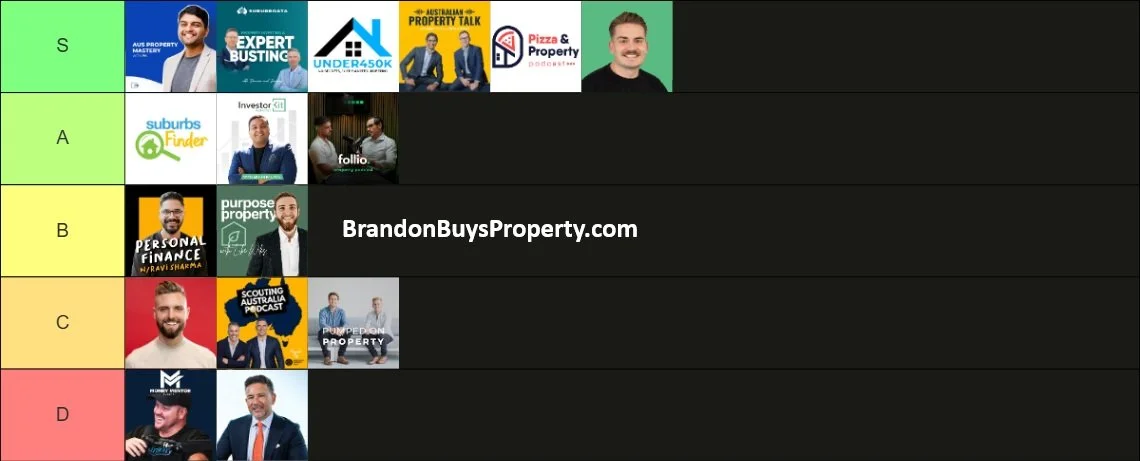
I am going to go a bit rogue here and it may ruffle a lot of feathers but to be frank, I don't care - I'm just some nerd on the internet so don’t get too offended. There is almost too much free information out there today, and almost of all of it is dominated by buyer's agents with ulterior motives, so I am going to cut through a lot of the bullsh*t and give you my raw opinions on some of the most popular online property investment content creators by ranking them in a tier list.
I haven't ranked every and all creators here - just those that tend to receive the most of amount of views on a consistent basis which I have watched. If I am missing anyone obvious just let me know via my email and I will add them in accordingly.
I think I will do a YouTube video explaining my specific reasoning for each individual creator so keep an eye out for that on my channel, but here are the general ground rules / criteria I have used in forming the below rankings:
The content must be actionable and not just generic ‘fluff’ that is essentially advertising for a buyer’s agency or course.
They must not consistently gatekeep information, such as refusing to mention locations that they believe are good investments or not giving insights into the metrics they look at for assessing locations.
The content must be accurate and consistent with using a data-driven approach to property investing.
Must have been creating content consistently for more than 6-months.
Additionally, where I have mentioned a few buyer’s agents below, these rankings are based off their YouTube property investing content it is not a ranking of the services they provide as I have not used them.
‘S’ Tier: PK Gupta, Suburb Data, Australian Property Talk with Redom, Pizza and Property Podcast, Davey Hamilton Property - ‘A’ Tier: Suburbs Finder, InvestorKit, Follio Property Podcast - ‘B’ Tier: Personal Finance with Ravi Sharma, Luke Wiles - ‘C’ Tier: Jack Henderson, Australian Property Scout, Pumped on Property - ‘D’ Tier: Money Mentor, Scott Kuru,
I highly recommend you go and binge watch these creators to build your knowledge base, including the bad ones so you know what not to listen to… and see if you agree with my rankings.
But if you are going to go out there a buy an investment property worth hundreds of thousands dollars, you should really go and spend a bit of money on your education and invest in a property investment course - because in property investing it really does cost at least some money to make money and to be honest it isn't actually that much money in the grand scheme of your investment journey, plus the return on investment will be far greater than the cost.
(b) Paid Resources - Property Investment Education Courses
You may immediately ask yourself, well if I'm paying money to learn how to invest why not just pay a buyer's agent to do it for me? I am sure you have heard of the quote "give a man a fish and you feed him for a day; teach a man to fish and you feed him for a lifetime" - well it applies here also. Most courses range from $3,000 - $7,000, which is half of a typical buyer's agent fee, except it's a once off fee because you now have the knowledge and can apply it as much as you want.
I know 'courses' have got a bad reputation these days from people in communities such as day-trading and cryptocurrency, but I can assure you there are actually some very good property education courses and resources out there that are not a 'scam' and are truly worth the money in my opinion. However, there are also some very bad ones so I am going to try give some guidance on those courses I think are worth the money.
PK Gupta - Property Investment Accelarator
One of, if not the best, course out there in my opinion is the 'Property Investment Accelerator' by PK Gupta. You will see I have linked a lot of PK's videos throughout this website and this is because he is in my opinion a fantastic source (paid and free) for independent property investment advice in Australia. I have set out a link below to the course landing page so you can get an understanding for the structure and its contents - for reference, the cost is currently approx. $6,000 - $7,000.
https://consultingbypk.com.au/course/
For those not familiar with the Australian property investment community / landscape, PK's course is essentially the genesis for the growth of the 'borderless investing' approach and his course has created a lot (and I mean a lot…) of buyer's agents - many people will be too proud to admit this, but it is the truth.
Whenever you see someone saying "you don't need a $6,000 / $7,000 course to invest in property" they are referring to PK's course and there is a 99% chance they have done PK's course previously.
For the record, PK has not paid me to say any of this and I've actually never even spoken to him in my life and to prove my objectivity please see the below pros and cons list for his course:
Pros
Independent and transparent - PK is not a buyer's agent and there is no upsell / upgrades in the course so you can trust that the information you are getting is as objective as you can get in today's property course market.
Very detailed and well-structured - the course essentially tells you everything you would need to know on how to purchase an investment property from start to finish (including data sources, analysis methodology, all team member recommendations for most regions in Australia, negotiation tactics and scripts etc.).
It is priceless for a newbie as it has everything you need in the one place.
Mentoring - as part of the course you also get access to the community platform where you can ask any questions you have and you can even email PK and his team with respect to specific deals you are looking at (they won't green light deals for you but they will answer any questions you have).
The mentoring is what seperates PK’s course from other free sources of property investing information on the internet - you can have all the information you want, but having an expert you can ask questions to and guide through the process is very valuable for actually gaining the confidence to pull the trigger on buying a property D.I.Y., for the firs time in particular.
Social proof - this course has the most social proof out all other property courses available - meaning there has been hundreds of real people who have done the course and achieved real results, which is why I think the price is justifiable. The course has also created a lot of buyer’s agents, whether they will admit it or not, and for less than half the price of a typical buyer's agent fee you can basically learn how many buyer's agent today analyse / identify investment grade properties.
Matija Djolic - HtAG Mastermind and Mentoring Sessions
HtAG is very quickly becoming, if it is not already, the leading data source and research tool for property investors and buyers agents in Australia. Matija is one of the brains behind this platform and he gives out countless amounts of property investing gold through his 'HtAG Mastermind' service which you get access to for free when you sign up to the platform. Noting that no matter what property investing course you do - you will likely need to sign up to a platform like HtAG anyway (it's about $180 for one month of access), so it is no brainer to check it out for yourself.
Matija also runs one-on-one mentoring sessions for approx. $650 an hour where he will take you through his exact research methodology using HtAG for your specific brief and show you how to figure out where to invest next. I have recently done of these sessions with him and I thought it was great value. I wouldn't recommend just jumping into one of these sessions straight away - you should work your way through the free Mastermind sessions, various educational posts, interviews with industry professionals and then think about getting a one-on-one session.
The only disadvantage to HtAG Mastermind is that it is primarily focused on the suburb selection process as opposed to the other parts of property investing process - which is completely fair given that is what the platform aims to do, but just something to note.
Nonetheless, irrespective of what course you chose - I think it is an absolute must that you check out HtAG and the Mastermind sessions if you are serious about investing. Also type in Matija's name into YouTube as he makes a lot of appearances on other people's channels and gives some awesome insights into the top investing locations.

Green flag
They are a boutique buyer's agency and only work with a small amount of clients at one time.
The agent you are working with (i.e. not necessarily the face of the agency, could be an employee) has been investing in property and their education for years and has an established portfolio already
They can recommend you certain mortgage brokers, accountants, conveyancers etc. if you need them and they do not take any referral fees if you do use them.
They have no waitlist because they don't take on too many clients or they have a short waitlist which they are very transparent about.
They encourage you to take your time and not rush into signing-up with them if you aren't sure yet.
They aim to educate you along the way (including in the initial discovery / introduction call) without charging you more for it.
They are borderless and the locations they buy in depends on the market cycle timing / conditions at the time you are purchasing.
The location they purchase in changes depending on your specific brief (i.e. purchase price, goals etc.).
Before you sign-up they are upfront about what regions / cities (doesn't have to be the specific suburbs) they are operating in most heavily in at the moment for your budget / goals.
They are able to clearly explain what their investing approach is and some of the specific data points they rely on (i.e. stock on market, days on market, vacancy rate, building approval rate etc.).
They make a conscious effort to understand your brief and only recommends that you sign-up with them if it aligns with their investing approach.
They only purchase established properties on good sized lots.
They purchase off-market and on-market.
Rationale
Just because a buyer's agency claims to be a large established company which spams you with social media advertisements and has paid for won heaps of awards that doesn't automatically mean they are a good buyer's agency. In fact, it often means the opposite.
These big companies have extremely high overhead costs (i.e. big office leases and heaps of employee salaries to pay), which means they are under a lot of pressure to keep churning through clients so they can collect their fees and pay their bills whilst also turning over a profit. That is just the reality of operating a big company - it is not an issue specific to buyer's agencies.
However, given property is a finite resource and there is a very limited amount of good stock available in the market at any given time, especially in the best markets, this often means that the big buyer's agencies will sacrifice quality and / or overpay in order to get deals over the line quickly so they can move on to the next one.
I often hear on YouTube about certain buyer's agencies actually bragging about buying hundreds of properties a month for clients (if you know, you know) and actively aiming to build the "biggest buyers agency in Australia" (why not the best rather than the biggest?). I can assure you that there is not hundreds of great deals available each month in the quality markets around Australia. I don't care if they have the best relationship with agents or whatever other marketing spin they want to push, it just doesn't add up.
That is why it is important to engage a boutique / smaller buyer's agency who has a compact team which only takes on a few clients each month. At a boutique agency you are more likely to get a specialised service where they are under less financial pressure and can take more time (if necessary) to identify a property for your brief that doesn't compromise on quality or price. Or in other words, they are comfortable with rejecting plenty of properties until they present you with what they consider to be the right one for you.
Whenever you engage a big buyer's agency you are also just one of many clients onboard at any given time and there will always be multiple people with the same / similar brief as you. So how do you know that you are the one getting the best deal at your price point? You don't. You could easily just be getting the rejected properties from one of the other 50 clients. Whilst this is also a risk in a boutique buyer's agency, the probability is much lower as there is likely only a few clients with the same brief as you (in which case priority is generally given to those clients who have been waiting the longest… not a perfect system by any means but it is far better than the alternative).
The amount of buyer's agents in Australia has more than doubled over the past five years and many of these new agents have only just started investing in which they saw some success through the 'COVID boom', where you could've bought almost anywhere and saw double digit growth, and now they think they can start earning a quick buck by becoming a buyer's agent for other people.
In fact, many of these newbie investors turned buyer's agents have only joined the profession to increase their borrowing capacity so they can continue to expand their portfolio past 1 to 2 properties. They aren't aware of how to actually invest in property using data and they have no understanding of market cycles because they are just familiar with the recent boom experienced as a result of COVID - in fact, if you have read this website I would dare to say you may know more than these amateurs by now.
This is why it is important to employ a buyer's agent who has an established property investment portfolio. I would be very sceptical of any agent with just 1 to 2 properties in a portfolio that is worth under $2 million in total, because they just don't have the runs on the board to be able to share with you their successes and mistakes that they have learnt along the way. Learn from those who have done or are doing what you want to do.
This is another reason why you want to avoid the big buyer's agencies because whilst the face of the brand on all the YouTube videos looks like a really successful property investor, the reality is that it is not them who is doing the work behind the scenes to secure you a property, it is likely some 23 year old on an entry level salary who has just finished university or high-school recently and has just got their real estate licence.
Don't let your financial future be the training ground for some newbie - work with a boutique agency where you get direct contact with the founder who is an established property investor.
If a buyer's agent will only work with you if you use certain members of their team, such as a mortgage broker or property manager etc., this is a major issue as it presents a clear conflict of interest as they are prioritising their interests (i.e. referral money, convenience and / or confidentiality) over yours.
Sometimes this conflict isn't as obvious as the buyer's agent flat out refusing to work with you but instead they may only give certain deals to those clients who use their recommended team. This is becoming more common recently with mortgage brokers in particular, where some of the bigger buyer's agencies are allegedly only giving deals in their 'new and upcoming' locations to those clients who use their recommended mortgage broker in order to avoid scenarios where a client's own mortgage broker leaks the location to other people / online (which in my opinion is extremely presumptuous for these agencies to assume they are the only ones investing in a certain location… it's not rocket science guys).
Instead, a good buyer's agent will have connections that you can take advantage of to build your team, but they won't get any monetary benefit from it and they won't force you to use them or disadvantage you in any way for choosing your own advisors - it's entirely up to you.
Greedy and unethical buyer's agents are not able to say no to clients, because they want their money, so when they are too busy to service some people at that point in time they will instead ask them to give them a deposit and put them on a waitlist.
Depending on the length of this waitlist they are as a concept not necessarily a problem; however, the issue is that many buyers agents are not transparent about this and will not inform clients that they are even on a waitlist or significantly downplay how long the wait will actually be - which results in people waiting months and months to hear from their buyer's agent. ultimately delaying their entry into the market and costing them thousands of dollars.
I have often heard stories from people saying they have waited more than 6 months on a waitlist at some of the bigger buyer's agencies… some markets would have grown by over $50k or more in that time.
Ethical buyer's agents won't have a long waitlist and instead just open and close their books as necessary, or, they will only keep a very short waitlist of a few weeks and be transparent about the average sourcing time with all clients before they sign-up.
Unethical buyer's agent may put a lot of pressure on you to sign-up as soon as possible because "the waitlist is getting bigger everyday", "we are raising our fees next week" or "we only have one slot left this month". Whereas a good buyer's agent understands that this is a big decision which involves a lot of money so they won't put any undue pressure on you or use slimy sales tactics. They may follow-up with you, but that is very different to implanting a sense of 'FOMO' in your mind if you don't sign-up soon.
I have discussed this already but if your buyer's agent is trying to sell you a course they are just trying to drag more money out of you and if they give preferential treatment to those who sign-up to the course then they are just pieces of sh*t - simple as that (if you are reading this, you know who you are…).
Good buyer's agents will educate you before and during the sourcing process without charging you additional money for it - they will tell you why they like an area / property and the specific data metrics that make it an attractive purchase so that you feel more knowledgeable about property investing than you did before you engaged their services. The great ones even answer your questions for free after you have finished with their services (mostly so they can get you back as a repeat client though).
If a buyer's agent always invests in certain locations and has done so since the start of their career - e.g. they are a [insert state] based buyer's agent, then in my opinion they are doing their client's a disservice as they are completely ignoring market cycle timing, as there is no market in Australia which is good to buy-in at all times
They will often use the guise of investing for the 'long term' as an excuse for the continuing to invest in the same location even if it is currently experiencing a stagnation / decline (or if other markets are simply better value at that point in time); however, as you now know from Step 1, you need to time certain markets so you can get both short term and long term growth.
For this reason it is important for your buyer's agent to be a borderless investor (which we also discussed in Step 1) so that you can be rest assured that they are considering the best markets in all of Australia to invest your money and not just the one location where they have decided to set-up some fancy office.
I know some of these buyer's agents will say they have been operating in a location for years and no one has the connections and knowledge that they do in their market… which may be the truth but this 'benefit' is not outweighed by money you will make by opening yourself up to all markets in Australia and timing your entry into them accordingly.
But what if I have done the research and know that [insert state] is at a great time of the cycle to buy in, then can I engage an area-specific buyer's agent? Well then yeah I suppose you could if you want, but at this point why not just go and do the purchase yourself, you have already done half the work…
An ethical buyer's agent will build out a list of potential areas for you to invest in after you have told them your specific circumstances. They may have a broad idea based on general market conditions but they won't finalise this shortlist until they know all the details about your brief. If a buyer's agent is just putting all their clients into a specific area they are doing a disservice to their client as everyone has different goals and circumstances - in reality they are likely doing this just because the area is relatively easy to buy in and / or they have a great relationship with an agent so they know they can get deals done quickly and keep collecting a lot of fees from clients.
You will understand this point more when we get to Step 4, but identifying the good areas to invest in is not rocket science and it is not some secret research process that only a specific buyer's agent has access to - you just need access to a few relatively affordable data platforms and some education. To be honest half of them mention the areas they are investing in on YouTube these days so it's hardly a trade secret.
For this reason, and the fact that you will be paying this person over $10,000 and giving them the keys to your financial future, it is entirely reasonable for you to be given some indication into what areas a buyer's agent thinks is appropriate for you to invest in if you were to sign-up with them.
This doesn't mean exact suburbs, but you need a general idea so you can ensure it lines up with your risk appetite and goals. For example, if a buyer's agent is mainly buying in Darwin right now but you aren't interested in a high-risk / volatile market like that then it is important that you know this information before you give them your money and time.
As I have mentioned many times and will explain further in Step 4, you need to be using various data metrics to assess whether an area is good to invest in (i.e. whether supply is low and demand is rising) - this does not mean how far a suburb is from the CBD or whether there are some nice parks and amenities nearby.
Good buyer's agents will be able to breakdown their investing thesis to you with reference to specific data points that they track, maybe not everything but enough for you to get confident they know what they are doing. Bad buyer's agents will say it’s a secret or give you some general rant about high-level things they look at and basically suggest you trust they know what they are doing because they have been helping clients for years, they won these awards, look at our Google reviews blah blah blah.
Following on from the above, a good buyer's agent wants to make sure that you are fit for them as much as you are assessing if they are a good fit for you - this is because they want to make sure that the types of properties they believe in are something that will be attractive to you also so that it is a positive experience on both ends. Unethical buyer's agents just want your money and will sign you up then just give you what you want, not what they think is a good investment, so they can move on to the next client. In which case you might as well just buy the property yourself…
We have already discussed the disadvantages in buying / building new properties - these people are spruikers, avoid them at all costs. They don't work for you, they work for the developer.
For those who don’t know, off-market deals are those that are not advertised to the public (i.e. not on realestate.com or domain) and are presented to the buyer's agent directly by the selling agent.
Off-market deals have become a key marketing strategy these days by buyer's agents in an attempt to show-off their relationships with selling agents to potential clients and because people often mistakenly think that if they are buying off-market they are getting a better deal. This is not always the truth.
The reality is that 99% of off market deals are off-market for a reason, because if they were on-market they would not get much interest and therefore not achieve a good price. Think about it logically, if you could pay a bit more money to market your property online and get a significantly better result by creating some competition amongst buyers why wouldn't you?
Additionally, these off-market deals that buyer's agents are presenting to their clients these days are not truly off-market deals. They aren't being posted online but they are being sent to many other buyer's agents and other potential buyers via email or group chats (yes, there are literally group chats sometimes filled with buyer's agents) - which is in effect still a market.
There are definitely still true off-market deals that actually present good value. These properties could be off-market for many reasons, such as the vendors really value their privacy, it may be a tenanted property or perhaps the vendors are quite cheap and don’t want to pay the marketing fees.
However, there aren't enough good off-market deals to warrant all these buyer's agents saying they are exclusively buying off-market. If they are doing this, they are compromising on quality because selling you on an off-market deal is much easier for them than trying to buy something on-market and it makes the selling agent love them more because they are selling properties much quicker and often at a higher price than if they advertised it online.
So make sure that any buyer's agent you engage is looking on-market and off-market for your property (you are paying them a lot of money, make them work for it…).
In terms of where to find these good buyer's agents, I would completely avoid any of those that you see on TV or social media advertisements. The best buyer's agents don't need to pump money into ads as they have an established pipeline of work from previous clients or referrals. Please check out these videos from Under450k which sets out how these major / big buyers agencies operate.
Please also don't blindly trust Google reviews or their client testimonials - these are just cherry picked deals / clients which can be very misleading. Instead I would check out some property forums and even YouTube as a starting point (similar spaces to where you can find a mortgage broker and accountant) - just make sure you watch out for the red-flags I have mentioned above, most of the incompetent buyer's agents are on YouTube / podcasts also...
It will take time to find a good buyer's agent, but remember this is a big financial decision so do your due diligence.
Working with a buyer's agent
The process of working with a buyer's agent will generally look something like the below. I have also included a bit more detail underneath this chart in case you are interested - for reference, this is not a full explanation of each step in general, as we will touch on these more as the website progresses, but is rather a summary of your buyer's agents involvement in each step of the process so don't worry if it doesn’t all make sense at this point.

1. Discovery / Strategy Call
This is typically the first conversation that you will have with a buyer's agency. In this call (sometimes it is split into two separate calls) they will try to sell you on why you should engage their services and also try to get a better understanding of your situation and what you are trying to achieve - i.e. what is your brief.
In these calls it is important to remember that the person you are talking to may be a salesperson (or at least acting in that capacity) whose sole job is to get you to sign-up. I often hear people recall their experiences during some of these introductory calls as it all happening so quickly and before they even got a chance to as questions they were already being sent the engagement letter to sign-up. Do not let them dominate the conversion and not give you a chance to ask the questions you want answered - remember their services probably cost $10,000+ so you deserve to ask questions.
In terms of what questions you should be asking, I would suggest using the above green / red flag table as a starting point to think of some questions that you can ask buyer's agents. Some example questions include:
How many clients do you take a month?
How many staff do you employ / how is your business structured in terms of your oversight? How involved are you in sourcing the properties that are presented to me?
Can you give me a breakdown of your services from start to finish of the purchasing process?
Will you be helping me all the way to settlement or do your services stop once the property is unconditional?
Will you be organising all the pre-purchase and pre-settlement inspections? Do you inspect them personally or get a property manager to do so, or do you rely solely on the agent's video?
If you aren't located locally to the property I will be purchasing what is your on-the-ground due diligence process?
Will you organise the building and pest inspection for me also?
Do you have a mortgage broker I can talk too, and do I need to use them or can I use my own broker?
Will you introduce me to a property manager and if so, is it always just the property management branch of the selling agent or do you have a specific contact you like to use in certain markets?
How long will take you to source a property for me generally? Is there a waitlist and if so, how long is it?
What markets are you most actively involved in currently and which of those do you think will suit my brief?
Will you be putting together a list of recommended suburbs specific to my brief before we start the sourcing process as I would be keen to understand which areas and why you like them from a data perspective beforehand.
What's your property investment journey been like? Can I have an understanding of your current portfolio?
Will you explain to me why you like a property deal when you send it to me?
What data metrics and sources do you look at when choosing a suburb to invest in?
Do you only buy established properties in areas with low supply and low building approvals?
How do you decide which clients gets offered a certain property first?
Do you have any referral relationships that you get kick-back payments from?
If they don’t immediately know the answer to these basic questions (or if they get frustrated / offended at your curiosity), then that means they either aren't the person who will be buying the properties for you or they are incompetent / unethical, and therefore that is not a buyer's agency you want to engage.
2. Waitlist
I have already given you my thoughts on waitlists in the green / red flag table, but just to reiterate my point, you ideally don't want to be waiting more than a week or two for your buyer's agent to start sourcing properties for you.
It is also important to note that sometimes buyer's agent will include the waitlist time in the average sourcing timeline that they provide you. For example, they may tell you that it generally takes them 2 months to get you a property, which on face value sounds like they are searching for you during the entire 2 months - but this may not be the case. Sometimes this timeline will include the 4 week waitlist and they have just decided to not tell you.
In order to minimise this risk you should set communication expectations with your buyer's agent from the get-go and let them know you would like at least weekly updates on how the sourcing is going and even ask them for examples of properties they have been rejecting if you are suspicious that you are stuck on a secret waitlist.
3. Sourcing Period
This is the part where your buyer's agent should be proving their worth and identifying potential deals for you.
Please remember that this actually can take time to do well, sometimes a deal will present itself within a few days and other times it may take a few weeks or potentially even a month depending on your brief and amount of quality stock on market. So don't be hassling your buyer's agent after a few days if they haven't given you a property to buy just yet.
One point to remember during this stage is that you should have a very clear idea of where your buyer's agent is sourcing. Or in other words, you should definitely have had a clear shortlist of suburbs / areas provided to you by your buyer's agent so you know where your potential property is going to be located. This shortlist should also be supported by data (similar to those data points we will discuss in Step 4) and agreed upon by you also.
My view is that the areas you are going to buy in should be agreed upon before you get sent a property, so that once a deal does come through to you its more about the property itself as opposed to the area.
4. Property Identified
Here is the fun part, you have been sent a deal by your buyer's agent and now it is time for you to make a decision - do you say yes or no.
It is important to remember that whilst your buyer's agent is the expert per-se, you shouldn't just be blindly saying yes to any deal that they send you. The buyer's agents are going to hate me for saying that but given it is your financial future at stake here I believe it’s a fair point, you are supposed to be working with them - they need to explain to you why they think a deal is a good deal and not just tell you "trust me this one is a cracker - it's under market value!!".
This explanation could come in the form of a video, phone call or email, they shouldn't just be sending you a property saying "please confirm if you are ok to proceed". You need to see the due diligence they have done and that they have checked for all major red flags - such as flood zones, busy roads, flight path noise, power lines, bush first zones etc. The exact issues you should be checking with them will be more clear after you have read Step 4 and Step 5 of this website.
This goes back to my education point I raised earlier, you need to make sure you are educating yourself on property investing because otherwise how are you going to know what questions to ask at this point? Yes I know you are paying the buyer's agent a lot of money to get this right but you should be fact-checking the fundamental points with them at this point so you feel confident and to make sure they haven't missed anything (they are still humans after all…).
But remember this key point, I am going to assume at this point if you are still with your buyer's agent it is because they haven't given you a reason to mistrust them - so there does come a point where you need to trust them. If you have reviewed all their due diligence materials, they have answered all your questions and there are no major red flags then says yes and do the deal - TAKE ACTION.
Do not overanalyse the deal and say no because you think there may be something better around the corner, property is not an exact science and no deal is 100% perfect - trust me, because I have been a victim of this myself, the best deal is the one in front of you right now that ticks all the non-negotiables / fundamental points.
However, if there is a clear red-flag or there is an element of the property that doesn't meet your initial brief that you gave the buyer's agent - e.g. you wanted a 3-bed 2-bath or the property isn't 500m2 or more, and it was agreed this was achievable in your price range (i.e. you aren't being unrealistic or chasing a property that isn’t achievable), then do not be afraid to reject the property. Good buyer's agents will take this feedback on board and continue the search.
One other key point to mention here is the time pressure to accept / reject a deal. Sometimes a buyer's agent will flag to you that a deal is urgent and that they need your response ASAP. This is an interesting point and there is a balance that you need to strike here - in some markets which are heating up there is actually a time pressure to respond and it isn't your buyer's agent being unethical trying to get a deal over the line but it may be an unrealistic deadline set by the selling agent. However, what is important is how your buyer's agent handles this timing pressure.
Irrespective of how 'urgent' a deal is, your buyer's agent should at least be giving you a few hours to digest their due diligence materials and ask questions before making you respond. If they are calling you every 10mins trying to get you to respond and telling you that you need to secure this deal now because who knows if there will be anything better around the corner - then that is not acceptable. You should look at the materials they send you as soon as you can, but if for some reason you don't respond in time (maybe you were in a meeting at work or at your kid's sporting game) then that is ok - if your buyer's agent is as good as they say they are then there will be other deals in the future so do what you can but do not stress too much if you miss out on a deal because of life.
5. Negotiation and Contract Review
If you like the property then the next step will be for your buyer's agent to negotiate with the selling agent to agree on a price and conditions of the contract.
Your buyer's agent should have already presented you with a suggested price and conditions (i.e. building and pest condition, finance condition and any other relevant special conditions to include in the contract).
One thing you must ask for here is their 'comparative market analysis' (i.e. CMA) which they used justify the price that they are suggesting you offer for the property. We will chat more about this in Step 6, but this basically is a list of the other comparable properties which have sold in the area which they have used as a reference to understand what the property you are about to buy is actually worth. Feel free to question them on this also, if you found a similar a property that sold a month ago for much less ask them why - they work for you and you are the one paying for this property, so don't be afraid to ask questions.
We will discuss conditions later on in this website, but one thing to note here, if your buyer's agent is not including a building and pest condition, or letting you know how they are going to organise one in any event (i.e. before an auction or during a cooling-off period), then this is a major red-flag and you should stop using their services immediately. Yes, this type of behaviour is that serious and extremely negligent.
Similar case with finance (except in an auction situation), unless your broker has said its ok to remove a finance condition, your buyer's agent should not be negotiating a contract which does not include a finance condition.
Once the price and conditions have been agreed, a contract of sale (COS) will be prepared.
Your conveyancer, whether they were suggested by your buyer's agent or is someone you found, should also be reviewing the agreed contract of sale before you sign it. This is absolutely critical, do not sign anything which hasn't been reviewed by a conveyancer - your buyer's agent is not a lawyer / conveyancer.
6. Building & Pest and Finance Condition
So if your buyer's agent has negotiated successfully and you have signed the contract that was reviewed by your conveyancer, then it is time for the conditions to be satisfied.
The finance condition is not a responsibility of your buyer's agent - which they should make clear to you. This is for you and your broker to sort out.
However, the building & pest condition should definitely be a responsibility of your buyer's agent (double-check with them). Your buyer's agent will introduce you to an inspector who will send you an invoice to do an inspection on the property, which you must pay beforehand. After this inspection they will send you a report noting all the defects and issues with the property.
I will go through the building & pest reports in a different section on this website, but your buyer's agent should be summarising this report and giving you their view on the issues and any options you may have - i.e. if you should terminate (e.g. termites identified or major structural damage) or if there is room to negotiate the price lower to fix some minor issues. However, make sure you also read the report and call the inspector yourself to get their general view on the property - the reports always seem scary, but all properties have some issues so give the inspector a call to see if there are really an dealbreakers.
Once these conditions have been satisfied (plus any other negotiated conditions) then the contract will be unconditional - meaning there is no way out. This is generally when the buyer's agent will also ask you to pay the remainder of their fee, or they may ask you to do this on settlement.
At this point, you should also be asking your buyer's agent for advice regarding insurance. Again, we will chat about this more a bit late on in this website but your buyer's agent should be guiding you through this process too.
7. Settlement
At this point your buyer's agent role is essentially finished - it is now between you, your broker and conveyancer to see out the process and get the deal to settlement.
However, your buyer's agent should be introducing you to a property manager who will liaise with you regarding getting the property tenanted as soon as possible. Do not feel obligated to automatically sign-up with this property manager just because your buyer's agent recommended them, chances are they are associated with the selling agent (see my section on property managers below for reference).
8. Post-Settlement
Unless your buyer's agent has agreed to help you with managing things such as a cosmetic renovation post-settlement then the only time you will hear from your buyer's agent is them asking you to leave a review or them checking-in to see if you are ready to purchase again (and if they have purchased well for you, they may suggest to you that you have enough equity from your previous purchase to go again).


Cons
Updates can be confusing sometimes - since the course was created a few years ago PK has not updated the video tutorials but he has issued updated written and video materials to cover any changes in data sources / methodology; however, this can be slightly confusing for some people to follow in my opinion.
Potentially becoming outdated in some respects - don't get me wrong, the fundamentals taught in PK's course have and will stand the test of time; however, as the property investing space develops over time there are various new tools and data sources which are being introduced and the course generally does not cover these.
The biggest example I can think of is that the course uses 'DSR' data (this will make more sense as you continue to work through this website, mainly Step 4), but many data sources which are arguably more user friendly such as 'HtAG' have been created, and the people from 'DSR' have even created a new data source called the 'DSR-3' so there is even a risk that the 'DSR' data source may be discontinued in the future (but they haven't said anything to this effect yet so this risk is just theoretical for now).
Noting though the analysis methodology taught by PK can be applied to other data sources quite easily so it is not a deal breaker but just something to keep in mind.
Experienced investors may already know some of the content - if you have been consuming a lot of property investing content over the years and / or already purchased some properties you may be aware of some of the information offered in the course.
For example, if you are very familiar with metrics such as days on market, stock on market, vacany rates, inventory levels etc. or you already know not about avoiding main roads, social housing etc. then things like the suburb selection and property selection criteria will likely not be ground breaking to you as similiar (but not exact) data points have been made available for free elsewhere on podcasts, YouTube and platforms like HtAG etc. - not saying you won’t learn anything new because knowing the data points is one thing and knowing how to interpret them is something completely different.
However, there are plenty of testimonials from experienced investors saying they have learnt a lot from the course but I just wanted to raise this point so some people can manage their expectations - if you are newbie I wouldn’t worry about this point at all, it doesn’t apply to you.

Other property investment courses to consider
If you aren’t a fan of the above options I have mentioned, you could also check out the ‘Property Blueprint Program’ from Under450k, the ‘Everything Property Investment Course’ from David Hamilton and ‘Level Up Property’ from Joe Tucker and Jef Miles (the founders of the Aus Property Investors Facebook group).
I haven’t properly done these courses so I can’t testify to how good they are; however, out of all the options available on the internet (excluding those I have mentioned) these seem to be worth the extra consideration as to whether they would be worth doing or not.
Under450k and David Hamilton are independent (i.e. they aren’t buyer’s agents) which is why I have recommended looking into them. I believe Joe and Jef have a buyer’s agency but they give away a lot of great content for free so they seem ethical / good faith to me.
Stay away from the courses produced by buyer's agents…
You will notice that out of all the property investment courses out there today I have only mentioned a handful… and almost all of them have been created by independent sources who are not buyer's agents. This is because as a general rule all the other courses which are created by the big buyer's agencies are horrible.
In my opinion, they are truly unethical because they are actually designed to not work - they don't want you to learn how to invest because if they did you wouldn't use their service and give them their $15,000 - $40,000 fee. These courses are essentially 'gateway drugs' to using them as a buyer's agent - which is why these types of courses generally tend to be much cheaper (usually around $1,000 - $3,000).
Some buyer's agencies even have the audacity to make you enrol in their 'education course' first or give preference to clients who have enrolled - if you see this offering from a buyer's agency, please do not engage them… even if you think all the supercars they brag about are really cool and 'inspirational' (if you know, you know…)
This type of unethical behaviour from certain buyer's agencies is the main reason that the D.I.Y. method has gained so much traction over recent years, because over 95% of the buyer's agencies in Australia f*king suck and are truly unethical (in my opinion…). There may not be a more corrupted industry full of incompetent douche-bags than the buyer's agency industry in Australia - apologies for the language here but a bad buyer's agent can literally screw up your entire financial future and what's worse is that the bad actors in this industry couldn't care less about the consequences of their actions and due to the lack of regulation in the industry they won't see any legal consequences either.
That is why it is important that if you are not going to do the D.I.Y. method that you ensure you engage an ethical and competent buyer's agent because they do exist and they can easily become your most important team member, but the good ones are rare… so let's discuss how to find them.
Option 2: Using a Buyer’s Agent
After reading the above you may think I have an agenda against buyer's agents, but that couldn’t further from the truth - I only dislike the unethical ones. The buyer's agent industry is growing rapidly whether you like it or not, and in which case I think the industry needs more great / competent buyer's agents because for a lot of people this genuinely is the right path to ensure they take action quickly.
Identifying a good buyer's agency
One thing I want to note from the get-go, in order to identify a good buyer's agent and disregard the unethical ones, you still need to educate yourself on property investing. This doesn't necessarily mean paying thousands of dollars for a course (but it is still a good idea in my opinion), but at least dedicate a lot of time to first digesting the free content available on the internet - such as this website and those other resources I mentioned above in the D.I.Y. approach. Because if you don't know what makes a successful property purchase and investor, how are you going to choose a good buyer's agent to do this for you?
With that said, let's take a look at a few red flags and green flags for buyer's agencies which you should be aware of:
Red flag
They claim to be a large buyer's agency who work with a lot of clients at the same time.
The agent you are working with (i.e. not necessarily the face of the agency, could be an employee) has only just started their investment journey recently and have zero or just one or two properties.
They make you use their referral partner / in-house mortgage brokers, property managers, conveyancers etc. (or give preferential treatment to those that do use them).
They are not upfront about the waitlist for them to find you a property or there is a very long waitlist because they don't turn away clients when they are busy
They put a lot of pressure on you to sign-up as soon as possible - they try to impose a 'fear of missing out' upon you.
They try to upsell you to purchase an education course and may even give preferential treatment to those who do purchase it
They only operate in specific locations at all times - i.e. the areas they invest in don't change depending on market conditions.
They put all their clients in the same location, irrespective of their specific brief / circumstances.
They hold their cards too close to their chest and won't give any indication on the areas they currently are purchasing in unless you sign-up with them.
They won't expand upon their investing thesis / approach and the data points they look at, or if they do, it is very basic such as infrastructure, population growth, train stations and schools etc.
They take on any and all clients that call them, regardless of whether your brief, goals or risk appetite aligns with theirs.
They try to get you to buy / build a brand new property.
They claim that all their deals are off-market.